
The Philosophy of Jane Addams and Hull House

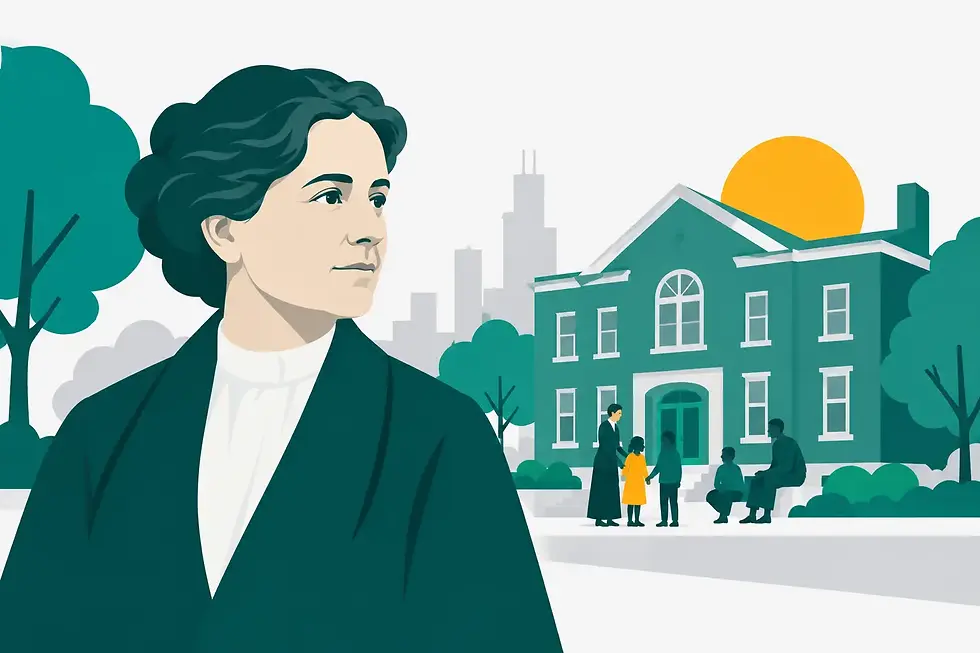
A house on Chicago’s Near West Side became a testing ground for a demanding question: What do we owe one another when we live side by side? The philosophy of Jane Addams and Hull House did not answer with charity alone. It asked people to cross the boundaries of class, culture, education, and comfort in order to build a more human common life.
Founded in 1889 by Jane Addams and Ellen Gates Starr, Hull House was a settlement house in a neighborhood shaped by immigration, industrial labor, and deep inequality. It offered education, childcare, arts, clubs, and practical support. Yet its deeper purpose was philosophical. Addams believed that a meaningful life cannot be separated from the conditions in which other people live. Wisdom had to become relationship, service, and action.

The Philosophy of Jane Addams and Hull House
Addams called her central moral idea “social ethics.” She challenged the belief that ethics belongs mainly to private choices: being honest, keeping promises, treating family well. Those things matter, but Addams saw that modern city life connected people in ways private virtue could not fully address.
A factory owner, a shopper, a teacher, a landlord, and a worker may never know one another personally, yet their lives are linked by the same economic and social systems. If those systems cause preventable suffering, individual good intentions are not enough. Ethical life requires attention to the whole web of relationships.
This was not an abstract theory for Addams. Hull House placed educated residents in close contact with their neighbors. They were not meant to arrive as experts who possessed all the answers. They were meant to listen, learn local realities, and share the work of improving them. The house itself was an experiment in living closer to the problems one hoped to understand.
That lesson still carries force. It is easy to form opinions about poverty, migration, public safety, education, or loneliness from a distance. It is harder to know the people whose lives are shaped by these issues. Addams believed that direct human contact could widen sympathy and make judgment more truthful.
Service is not pity
Hull House provided needed services, but Addams resisted a model in which one group gives and another merely receives. She saw dignity in the cultures, skills, aspirations, and knowledge of the immigrant communities around Hull House. Residents organized art programs, music, theater, lectures, labor advocacy, and clubs because a flourishing human life needs more than material survival.
This is a useful distinction for anyone drawn to volunteering. Service can become a way to feel useful while keeping another person at a safe distance. Addams asked for something more challenging: reciprocity. The person who serves must also be willing to be changed by the encounter.
Such reciprocity does not erase differences in resources or responsibility. If someone has greater access to education, time, influence, or money, they may have a real duty to act. But the manner of action matters. The question is not only, “How can I help?” It is also, “What can I learn here, and what can we create together?”
Democracy as a Daily Practice
For Addams, democracy was more than elections and institutions. It was a habit of recognizing that every person has a claim to participation, respect, and meaningful contribution. Democracy becomes real in workplaces, neighborhoods, schools, families, and civic associations, wherever people learn how to cooperate across differences.
Hull House encouraged this practice by creating spaces where people could meet through shared activities. Its clubs, classes, performances, and discussions mattered because culture can make strangers less strange to one another. A poem, a meal, a play, or a conversation may not solve a political conflict by itself. But these experiences can develop the imagination needed to see another person as fully human.
Addams also understood that democracy requires courage. Listening may reveal tensions that polite distance had concealed. People will have competing needs and unequal power. Real community is not the absence of disagreement. It is the patient effort to address disagreement without withdrawing into indifference or contempt.
This is especially relevant in a large city. Chicago offers extraordinary variety, energy, and creativity, but it can also make it possible to remain enclosed within a narrow routine. We may work, commute, shop, and return home without encountering the wider life of our neighborhood. Addams invites us to ask whether our habits make us more awake to others or less so.
Knowledge must meet experience
Jane Addams was a serious thinker, but she did not treat ideas as possessions to display. She tested them against life. Hull House residents studied social conditions, gathered data, and advocated for reforms in sanitation, workplace safety, child labor, and public health. Thought and action strengthened one another.
This approach avoids two common mistakes. Action without reflection can be impulsive or poorly directed. Reflection without action can become a refuge from responsibility. Addams offers a middle path: study carefully, encounter reality directly, act with others, and remain willing to revise your understanding.
Her work also shows why culture belongs in a life of service. Art was not an extra decoration added after serious needs had been met. It was part of human development. Music, literature, craftsmanship, and beauty can restore a sense of possibility. They remind us that people are not defined by their hardships or usefulness to an economy.
A Necessary Tension in the Settlement House Ideal
The settlement house movement carried a genuine tension. Its residents often came from more privileged backgrounds than the communities they entered. Good intentions could slip into paternalism if they assumed that educated reformers knew best. Addams was attentive to this danger, and her philosophy developed through experience, criticism, and deeper contact with the people around her.
We should not treat Hull House as a perfect model to copy unchanged. Its historical context was specific, and no institution is free from the limits of its era. The lasting value lies in its discipline of self-examination. Are we serving a community, or trying to control it? Are we listening for wisdom that does not sound like our own? Are we willing to change the structures that benefit us?
These questions make service more demanding, but also more honest. They move us from a desire to appear compassionate toward the harder work of becoming responsible participants in a shared world.
Bringing Addams’ Philosophy into Ordinary Life
We do not need to found a settlement house to practice this philosophy. It begins wherever we choose contact over isolation and contribution over passive concern. A person might volunteer consistently, support a neighborhood cultural program, learn the history of their community, or make room for a colleague whose voice is overlooked.
The scale matters less than the spirit. Addams did not separate personal growth from social responsibility. She understood that character forms through repeated choices: to pay attention, to learn, to cooperate, and to act when action is needed.
A practical starting point is to notice one place where your life intersects with people whose experiences differ from yours. Resist the urge to arrive with a solution. Begin by observing, asking, and returning. Trust is rarely built through a single impressive gesture. It grows through presence.
This is philosophy in its most living form. It asks not simply what is true, but what kind of person we must become if truth is to shape the world around us. At New Acropolis Chicago, in the Ravenswood neighborhood, we study philosophy as a source of this kind of inner clarity and outward responsibility, joining reflection with culture and service.
Jane Addams leaves us with a hopeful challenge: a better society is not made only by exceptional leaders. It is made when ordinary people refuse to believe that their lives are separate from the lives of others. Each sincere act of understanding, each effort to build something together, helps make community more real.
Frequently Asked Questions
What is the philosophy of Jane Addams?
Jane Addams held that ethics cannot stay private. Because city life ties people together through work, trade, and shared systems, she argued that being good also means attending to the conditions other people live in. She called this social ethics, and she tested it through direct contact with her neighbors at Hull House.
What was Hull House?
Hull House was a settlement house on Chicago’s Near West Side, founded in 1889 by Jane Addams and Ellen Gates Starr. It offered education, childcare, arts, clubs, and practical support, and it placed educated residents beside their immigrant neighbors to learn from them and work with them.
Was Jane Addams a philosopher?
She is best known as a social reformer and as a co-winner of the 1931 Nobel Peace Prize, but she was also a serious thinker. Her book Democracy and Social Ethics, published in 1902, argued that ethics has to include our shared life in the city, and scholars place her within American pragmatism, the tradition of John Dewey and William James.
How can I practice Addams’ philosophy today?
Notice one place where your life meets people whose experience differs from yours. Resist the urge to arrive with a solution. Begin by observing, asking, and returning, because trust grows through presence rather than one impressive gesture.
If you would like to explore questions like these in good company, the first class is always free at New Acropolis Chicago.
Written by the New Acropolis Chicago Team
Authorship Note
The philosophical content and teaching methods are consistent with the values of New Acropolis Chicago. While artificial intelligence assisted in organizing the article, creating image artwork, and translating ideas into clear, practical language, the final outcome is a product of collaboration between humans and artificial intelligence.


Comments